El Sistema

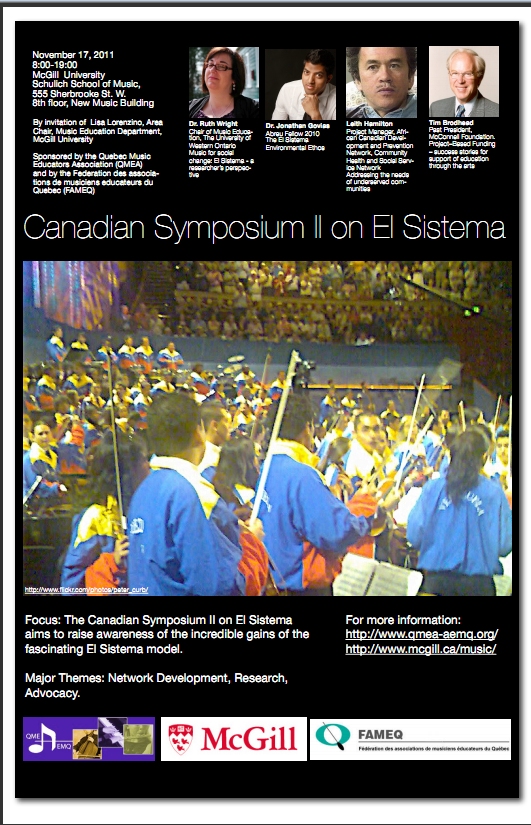
t the heart of El Sistema is a simple idea: using the classical music ensemble experience to promote positive social change in youth.
It works because in a musical ensemble, there is diversity of role yet unanimity of purpose and direction. In an ensemble, there is no success for one without success for all. And unlike sports, an ensemble’s success is measured only against its potential; its victories are not contingent on others being vanquished.
The idea behind el Sistema is powerful, it is inspirational, and it bears investigation from many different angles because its implications and effects are multidimensional. Its potential touches infants in arms and yet reaches to multi-billion dollar industries at the same time.
F R E Q U E N T L Y A S K E D Q U E S T I O N S
1. What is El Sistema?
2. What does the word Sistema mean?
3. Where did the name el Sistema come from?
4. How is El Sistema different from music education in other countries?
5. What is the music education method that they use?
6. If there’s no “method,” how are activities coordinated nationally?
7. Is it orchestra only?
8. Is it only classical music?
9. How is it funded?
10.Is it an initiative of the Chavez Administration?
11.Does el Sistema report to a particular government department?
12.Does it work?
1. What is El Sistema?
It is a high-frequency Venezuelan music ensemble network, founded by Maestro José Antonio Abreu for the purpose of promoting the collective and immersive practice of music as a means of social development. It is offered to young people without discrimination in terms of prior musical training, or ability to pay. As a national network it encompasses close to 300 different schools or núcleos, as they are called in Venezuela, and over 350,000 current students.
2. What does the word Sistema mean?
Sistema simply means “system,” and the word in this context is synonymous with “network.” The Venezuelans used the word Sistema much in the way we talk about a health care or judicial system, not referring to one procedure or process, but a coordinated network of services.
3. Where did the name el Sistema come from?
El Sistema is nothing more than the shortened form of the old and extremely unwieldy government name for the Venezuelan national youth orchestra network. The new official name is La Fundamusical Símon Bolívar, after the South American revolutionary hero.
4. How is El Sistema different from music education in other countries?
The primary objective of el Sistema is to effect positive social change, but through the pursuit of musical excellence. It employs situated learning, i.e.: learning on the job, and recognizes that a love of music making is the best way to motivate the development of refined practical skills.
5. What is the music education method that they use?
Pedagogically it’s almost entirely decentralized, with the individual núcleos having significant authority to develop programming that is sensitive to local needs and resources. As such one cannot generalize about curricula, standards, or the specifics of what happens on a day to day basis at the many núcleos because of the inbuilt flexibility.
6. If there’s no “method,” how are activities coordinated nationally?
All núcleos in Venezuela adhere to Five Fundamental characteristics. They effect social change through the pursuit of musical excellence. The primary format is the ensemble. The groups meet often – as much as six times a week. No one is denied access based on prior training or ability to pay, and all the núcleos are connected to share human or physical resources and provide an expanded network of opportunities for program participants. For a more detailed discussion, please see this article.
7. Is it orchestra only?
El Sistema started out as an orchestral program, but has since branched out into choral, big band, and indigenous instrumental ensembles as well.
8. Is it only classical music, that is to say, music from the Western European tradition?
No. Although that repertoire still constitutes the majority of the music performed in Venezuela, El Sistema has embraced many other musical traditions as well.
9. How is it funded?
The vast majority of the budget comes from the Venezuelan federal government. Financing for certain major capital projects has been provided by the InterAmerican Development Bank.
10. Is it an initiative of the Chavez Administration?
No. The program was founded in 1975 and has existed and grown through six different administrations, eight if you count interim, included the current one led by President Hugo Chavez.
11. Does el Sistema report to a particular government department?
Not any more. As of early 2011, oversight of the Fundación shifted from the office of the Vice President to that of the President. It was previously housed by different social service departments such as Community Development, but NEVER by a department of Arts or Culture, given its explicit social mandate.
12. Does it work?
Absolutely. In 2006, as part of its due diligence before approving a loan of $150 million USD, the InterAmerican Development Bank commissioned a rigorous evaluation of the activities and impact of the Fundación. The report found that program participants experienced significantly improved life and career outcomes over non-participants, including a 20% improvement in school drop-out rates. Outside of Venezuela, many of the programs inspired by el Sistema have seen similar results.
Special thanks to Chris Nicholls of Sistema Australia for his invaluable assistance with the FAQs.