At my research presentation at ISME 2016 in Glasgow, I proposed the idea that all social action through music, without exception, takes place on a continuum of relative degree of participant harm/benefit. At one end I placed the benevolent healing clinicism of music therapy; at the opposite end, the use of music to cause psychological or even physical injury, with all other forms of musical interventions falling somewhere between.
I chose the metric of participant harm to draw a sharp distinction between intention and outcomes – particularly human outcomes, as opposed to technical or artistic. Intention is an extremely unreliable and illusory measure, simply because everyone thinks they’re doing the right thing. (If you haven’t read the Guardian article linked above, go back and do it now, and marvel at the Schadenfreude of the perpetrators being interviewed). In my own example of my work with the youth orchestra in Colorado, I genuinely believed that my approach was musically and pedagogically correct, and that the students would benefit from it. Technically, the outcomes were excellent, but the history of music education as a whole is essentially one of excellent outcomes for a chosen few being achieved through manifestly anti-social if not unethical means. That doesn’t make the approach right. The end cannot justify the means.
But technical achievement does make it hard to convince others the approach is wrong. Worse, how audiences reacted to the performances of Venezuelan orchestras demonstrated just how easy it is to conflate technical outcomes with human or social. “They played so well, so they must be better humans for it,” is the typical false equivalency still promulgated by the Sistema crowd.
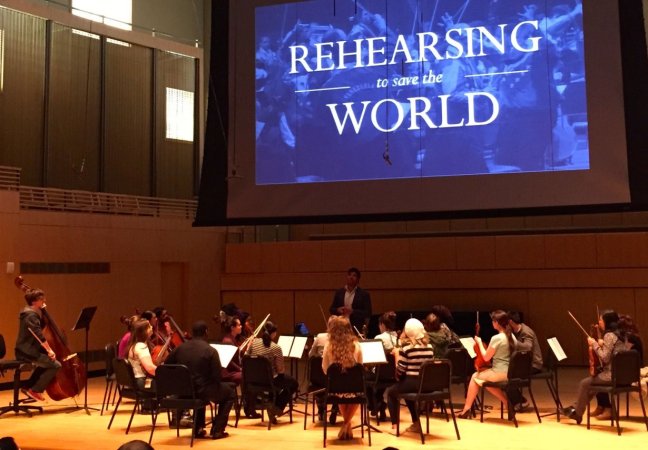
And even if equal or better technical and artistic outcomes are achieved through demonstrably more ethical means, there is inevitably defiant pushback. At the Sistema conference at UMBC in 2016 (it was a very busy year), I did a demonstration rehearsal with a group of musicians, none of whom had any advance preparation. Later peer review assessment of the session noted the extraordinary outcomes achieved very quickly. Yet the one conductor in the group of three live respondents was extremely defensive and took his moment to reinforce his belief in his own centrality. (The other two respondents were music education specialists and had very different takes.) When confronted with a better way, this “Sistema” conductor retreated to defensiveness and reasserted the value of the conductor-centric approach, utterly oblivious to the irony inherent in that concept. He was going to teach the way he had been taught.
If the student doesn’t get it, is it the fault of the student or the teacher? I’m not a fan of the bi-value logic of the statement (the student needs to accept they might have something to learn), but I do bear some responsibility here for his reaction. Even highly seasoned music educators have been mystified by how some outcomes are produced under tools or techniques I advocate: one went so far as to describe it as “voodoo.” It’s not magic, it’s Clarke’s Third Law. The underlying processes are simple, but if you don’t understand them, they appear to be of supernatural origin.
Let’s stake a step back, and start by resisting the inference that music education is a slippery slope where budding Neros (Caligulas might be a better, if more obscure reference) cut their felonious teeth by bossing about a middle school band before progressing to the sexual assault of students. It happens, but it happens rarely (even then still too often). Most reasonable, self-regulating adults respect certain boundaries, whether these are self or externally imposed – externally through law or policy. At one extreme, there are serious concrete legal consequences to violating the physical sanctity of another person. But at the other pole, the marginal practices of the unjustly singled-out middle school band instructor, the guardrails are considerably more abstract: educational ethics, personal philosophy, and/or basic human decency. The abstraction inherent in these is in direct proportion to their flexibility when it comes to justifying poor teaching practices. But this flexibility is still not an indication of malice. Our much-maligned theoretical practitioner is more likely motivated by the same unthinking combination of good intentions and poor understanding of consequence that marked my own time with the youth orchestra.
So in confronting the question of how to solve the problem, how to break the cycle in music education of teaching the way we were taught, perhaps what is needed is not a formal articulation of praxis, a handbook of method, or a proof of concept (all of which exist and are readily available for multiple sub-disciplines) but a simple yet concrete guardrail that will both challenge and inform all activities thereafter.
I’ll wrap this series up with the next post, I promise.
 Jonathan Andrew Govias
How did you conceptualize social action through music on a continuum of participant harm and benefit?