Anybody who thinks I dwell in an ivory tower of music education, content to comment from afar, is sadly mistaken; as one of perhaps two Abreu Fellows who have at least one child, I’m aware how profoundly my daughter will be affected by all the choices my wife and I make for her.
We should pay children to read great literature. It has manifest educational and social benefits. It’s not a foreign idea to be immediately despised; it was hatched in America. It’s not socialist or morally objectionable; it’s just early exposure to capitalism in that it concretely rewards effort.
The answer isn’t a Marxian redistribution of wealth, but improving and leveling educational quality. Not achieving equalization of educational outcomes, the unobtainable and highly socialist fantasy of No Child Left Behind, but ensuring equalization of educational opportunity - a process that demands equal access to music education.
Orchestras are living, thinking organisms, all related biological entities of a clearly defined, if endangered genus, but each unique, with a distinct character and temperament. They aren’t mass-produced hunks of machinery, no matter how fine the engineering.
In an era of great social challenge, music educators and professional musicians have by and large been relegated to the sidelines, lacking not the will but the knowledge of how to help as society has bled out in front of them.
Instruments represent the number one capital expenditure of any Sistema initiative, even very few purchase them new. The default option, the “instrument donation drive,” has evolved into a rite of passage as part of a program launch. It’s excellent publicity, and it reduces start-up costs considerably, although not entirely. There’s no such thing as a free viola: the instruments that are donated always require some degree of maintenance or repair, especially strings. Even once restored to playing condition, they continue to need constant care, especially strings. They’re also extremely fragile…especially strings
...successful corporate solicitation is the current holy grail of arts organizations. Any illusions Canadian and British groups previously held about the reliability of government funding have been utterly shattered in the last two years, and Americans never had government funding to speak of in the first place...
Whenever I hear debates over different music education philosophies or approaches, particularly among Sistema advocates, it seems that the practitioners under discussion are often reduced to one of two factions: the stodgy, elitist, arrogant, stiflingly inflexible guardians of the Western European tradition, and the socially-conscious, democratizing, innovating, free-wheeling, passion-producing proponents of el Sistema and other … Continue reading Coast to coast
Governments govern by our grace alone. A simple awareness of the right to negotiate , of a viable alternative, might be sufficient to enable bi-partite discourse, to change a culture with consensus rather than through the forcible contract rewritings witnessed in recent years.
Hot on the heels of the first Canadian Symposium on el Sistema in May at the University of Western Ontario comes the pragmatically named sequel The Canadian Symposium II on El Sistema at McGill University, Montréal on Thursday November 17th. I'm assuming my presentation back in May at UWO wasn't terrible, because I am … Continue reading El Sistema Conference announcement!




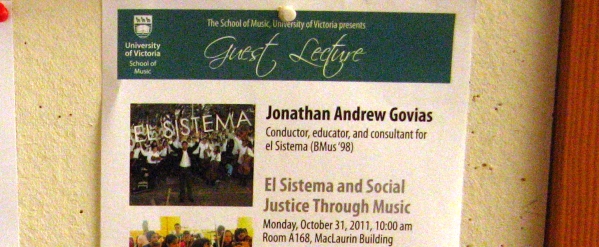


 Jonathan Andrew Govias