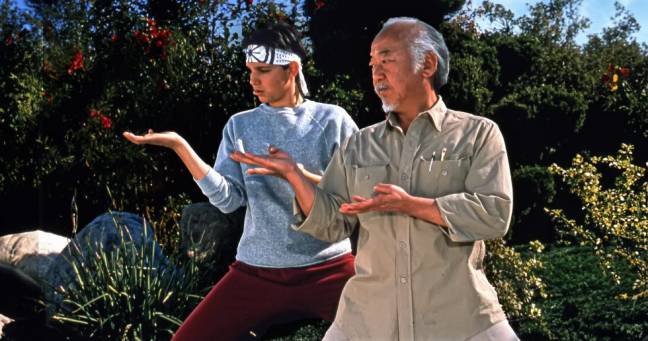
For my Introduction to Conducting class, one of the first assignments is to watch a clip from the 1984 film The Karate Kid. If you didn’t click the link, in the segment, the eponymous kid aka Daniel (Ralph Macchio) angrily confronts his sensei Mr. Miyagi (Pat Morita) over the hours spent in menial labour on Miyagi’s property, performing ignominious jobs like painting fences, sanding decks and waxing the car, when Miyagi had promised to teach him karate. Daniel’s exhaustion and annoyance at the perceived pointlessness is the setup for Miyagi’s dramatic punch/chop when Miyagi reveals that the specific gestures and motions he insisted that Daniel use while completing the tasks are in fact intended to build muscle memory for basic karate forms – forms that Daniel has now mastered.
I start class discussion of the video with the question: “Why was this clip assigned?” There inevitably follows a significant pause, which reveals that the first question they should have asked themselves was the last that came to mind. And the usual response, when finally proffered, is simply an expression of the same mindset that unthinkingly accepted the video as having pedagogical worth: “Because it shows the student should always obey the teacher.”
If we truly teach the way we were taught, then that idea is the single most pervasive and simultaneously unethical teacher-serving trope passed down through the generations. But Karate Kid is cinematic entertainment, not a training video, and Morita’s clichéd Asian guru mystique is enhanced by the revelation of how Daniel’s waxing skills transfer to deflecting punches. But this in turn leads to Question No. 2: is this good pedagogy? This is where the debate usually starts in earnest, with some class members seeing only the outcomes, and others observing that students who experience frustration and physical pain are not likely to progress as quickly. Which in turn leads to Question No. 3: would Daniel have been more motivated and paid greater attention to proper form had he known the purpose of the tasks? Or more simply put: could the same or better outcomes have been achieved through a more transparent approach?
My wrap of the video discussion goes something like this:
“Learning conducting is no different from learning an instrument or other physical skills. A certain amount of basic physical repetition is required to build independence of hands and technical flexibility. Part of the coursework this year will include mastering physical tasks of manual dexterity, the conducting equivalent of ‘rubbing your belly while patting your head.’ This is not exciting. It can feel pointless. The difference between me and Mr. Miyagi is that I want you to understand right now that this is an essential and inescapable part of developing your skills, and that what you acquire through the process will have immediate value. I hope by telling you this you apply yourself to these exercises with intention. I also hope you will never hesitate to ask if you don’t understand why I am assigning something – in fact, I expect that to be the first question.”
Acquiring a highly refined skill, be it an art like music or dance, or a sport like football or hockey, is not always going to be fun. Music is not all concerts, sports cannot always be matches. At almost all stages some level of drudgery, of repetition, of building fundamentals, will be required. In music this is not an abuse of the conservatory system: the abuse is committed through the great parental and pedagogical cop-out “because I said so.” At best this exhibits extraordinary arrogance. At worst, it betrays the instructor’s own lack of comprehension of the purpose and function of the task. It betrays the instructor’s unsuitability for instructing.
Yes, we teach the way we were taught. If that’s THE PROBLEM then the first of the subset of issues spawned by it is the attitude endemic among music educators, the unfounded belief that any suggestion of change must automatically imply seismic shift and the consigning of all our accumulated knowledge to the dustbin, rather than incremental but critical evolutions that dramatically shift attitudes, outcomes, and survivability (a word I’m going to use much more often when talking about music education).
Case in point: I can’t claim credit for the idea of using this video. One of my former conducting teachers made his students watch it, but with the sole purpose of reinforcing his absolute authority and his expectation of our unquestioning obedience. He was (and likely remains) a relentless bully and substance abuser, a Bela Karolyi of conducting, but he is famous and retained by a major music school, and therefore is untouchable regardless of his personal excesses or defects. I use the same video he does, but I choose to draw contrasting conclusions. I ask the students for their trust and structure the course so that the trust is rewarded very quickly. Same materials, similar methods, but very different communication, better student outcomes.
The real challenge is that THE PROBLEM is self-perpetuating, self-replicating. The solution to THE PROBLEM does not require a scorched earth approach to the history and traditions of music teaching , it just demands an open mind – the very thing THE PROBLEM is designed to crush.
THE PROBLEM Part 2 or THE PROBLEM2?
To be continued…

